A Cry with Tears
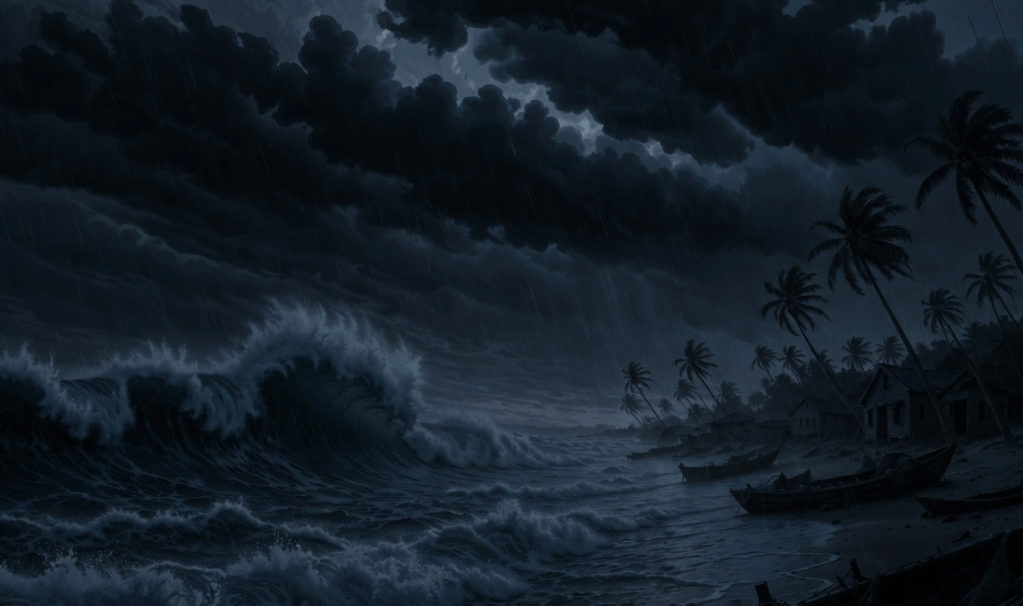
The tide had receded, leaving the sand slick and glimmering beneath the relentless noon sun. The beach stretched endlessly—a pale ribbon kissed by restless waves. Its shoreline was broken only by the jagged shadows of half-sunken wooden boats. Coconut trees leaned like tired sentinels over the barren dunes, their fronds brushing against one another in a hollow, wind-borne murmur.
Rusted nets lay tangled along the tide line. Scattered shells caught the sunlight like fragments of forgotten lives. The waves rose and fell with patient insistence, erasing the footprints of the past, while gulls circled overhead, their cries piercing the hush of a place abandoned—yet profoundly alive.
Amid the coconut groves stood a cluster of old houses—small, broken, and empty—separated by narrow patches of land.
Only one house among them had its roof intact.
Its doors were broken.
Inside, a twenty-three-year-old man lay on a bed. Beside him, on a light-brown plastic step stool, sat a pink cylindrical plastic jug half-filled with water.
This was Aarav Pattil—a man the world believed had died in a fire along with his mother.
A woman in her thirties sat nearby, reading a magazine. She heard the sound of the jug falling to the floor as she turned a page.
She looked up.
Aarav was trying to sit up, wobbling.
She rose quickly, hurried to him, and held his hand, concern written across her face.
Just then, a tall woman in her twenties entered through the doorway. Vibrant by nature, she wore a white tank top and blue jean shorts.
“You woke up?” she asked, smiling brightly.
Aarav clutched his head as a sharp pain surged through him.
“W… who are you? Where… am I?” he asked, his voice broken and hoarse.
“Don’t you remember?” she said gently. “We met about one and a half months ago. In that alley. I was wearing a windbreaker.”
Aarav suddenly froze.
Then, in a burst of panic, he jumped off the bed.
“M—MY MOM! WHERE IS SHE?” he shouted, terror flooding his face.
The woman’s smile slowly faded.
“Aarav,” she said quietly, “you need to calm down and listen to me.”
He didn’t respond.
“Your mom was killed, and—”
Before she could finish, Aarav lunged forward, his fist aimed at her face—rage and grief twisting his features.
In a swift motion, the older woman leapt up. She caught his arm, kicked his leg out from under him, and pinned him to the floor, twisting his arm behind his back.
Aarav struggled violently but couldn’t overpower her strength.
“RELEASE ME, YOU BITCH!” he screamed, his face pressed sideways against the floor.
“Release him, Kajjo,” the younger woman said.
Kajjo immediately let go and stepped back.
Aarav staggered to his feet, wincing from the pain in his twisted arm. He walked toward the younger woman and grabbed the fabric of her tank top.
“I don’t believe you. I will never believe you! My mom is not dead! Got it? She’s… she’s… al—”
His voice broke.
Tears rolled down his cheeks.
“She’s alive… right? Tell me… please…” His voice rose again. “TELL ME SHE’S ALIVE!”
The woman placed a warm hand against his cheek.
“You already know what my answer will be, don’t you?” she said softly.
His knees trembled.
He collapsed onto the floor.
“Why…?” he whispered after a long silence.
“Because she—”
“Not why her,” he interrupted, his voice hollow. “Why am I alive? I should’ve died with her. I don’t give a damn about a world without my mom. She… she was the only person I truly cared about. I was faking everything with everyone else. I don’t want to live in a world without her.”
He looked up at her, his entire body shaking.
“Please… help me kill myself.”
The younger woman crouched beside him and placed her hand gently on his shoulder.
“Many people don’t have the luxury to decide when they die, Aarav. And many people have the power to decide another human’s fate. Some unlucky souls meet such people—and their death is decided for them. Your mother was one of those unlucky souls. You are not. You might have been… long ago. But your mother protected you. For a very long time.”
Aarav stared at the floor, his eyes sunken with grief.
After a few minutes, he spoke in a faint voice.
“Your name… Dalaila?”
She paused.
“My real name is Sabo.”
Silence lingered.
“Why am I alive?” he asked again.
Sabo stood and picked up the fallen jug. She walked to the water filter near the wall, refilled it from the nearly empty translucent can above it, and returned.
She handed him the jug.
“It has… and does not have… something to do with your father.”
Aarav’s eyes slowly widened.
He drank from the jug, then let it fall loosely to the floor.
“I… I’m adopted,” he muttered.
“No,” she said firmly. “That was a lie your mother created to confuse her enemies.”
“Indr—I mean, the person who…” He hesitated. “He also implied I wasn’t adopted. Was he telling the truth?”
“Yes. You were born to Yodhika—the woman you knew as Avanthika. She changed her name, her personality—everything. Even the truth that she was your real mother. She kept you away from her family to keep you safe. Until the day she died.”
Aarav’s breathing slowed.
“The ones who killed her… were her family?”
“Yes. The man who killed her was Rudransh. Her youngest brother. They belonged to a clan called Pranvar. They once ruled an island near this country—Avantaveera. It no longer exists.”
She paused briefly before continuing.
“Your father was from the same island. From a clan of immortals—the Amirthyas.”
Aarav stared blankly.
“What is my father’s name?” he asked quietly.
“Rudhra. One of the most fearless fighter of his clan.”
The words drifted in and out of Aarav’s focus.
“How are they immortal?”
A flicker passed through Sabo’s expression.
“I don’t know the exact reason. But for centuries, their clan members have not died naturally.”
“Where are they now?”
She hesitated.
“They’re all dead.”
Aarav gave a faint, hollow smirk.
“How can immortals die?”
“There exists a black stone,” she said carefully. “Tamaskara.”
Silence.
“Am I alive because of my father’s lineage?”
“When I found you,” she said slowly, “your body was covered in fire. Completely burned. And then… suddenly… you started breathing again. I extinguished the flames and brought you here. The next day, the burns began to fade. Your skin started regenerating.”
She shook her head.
“It was impossible. I don’t know the full answer. And you won’t either… until you hear the full story.”
Aarav leaned back slightly, exhaustion replacing rage.
“I’m in no mood to listen to anything.”
Aarav fell back onto the floor and wrapped his arms around his bent knee.
Sabo stood up. “I know it’s a lot to process. Take rest now. We’ll talk later.”
She walked toward the exit, then paused at the door and turned back. “If you need anything, tell it to Kajjo. She’ll take care of it. She can’t talk, so don’t misunderstand if she’s not responding.”
Aarav glanced at Kajjo, then lowered his gaze to the floor. Kajjo sat on the chair, quietly reading her magazine.
Images of his mother’s birthday flashed in his mind— broken fragments. His breathing grew heavy as tears rolled down his cheeks again.
Suddenly, he stood up and ran out of the room.
Kajjo didn’t move. She simply turned a page.
He rushed out of the house. Outside, Sabo was breaking a coconut. Aarav stopped for a moment, looking around as if lost between worlds.
“You okay now?” Sabo asked.
He didn’t respond. He ran.
He ran straight toward the sea.
Sabo sighed and continued breaking coconuts.
Aarav plunged into the water. The waves rose to his chest, then his neck. A sudden surge crashed into him, knocking him off his feet. The sea pulled him deeper.
He cried—violently, helplessly.
You don’t deserve to live, you coward.
His expression hardened as tears dissolved into saltwater. His lungs screamed for air. He clutched his throat as he sank further into the Arabian Sea.
Darkness crept in.
His eyes slowly closed.
His life flashed before him—fading even as it appeared. Memory after memory dissolved into nothing. His mind emptied.
Then—light.
A sudden, blinding presence within him.
He felt himself separate from his body. He saw it—still, lifeless—resting in the depths. The ocean floor stretched beneath.
And he rose.
Upward.
Beyond the surface.
Beyond the sky.
Beyond the Earth.
Beyond the solar system.
Beyond galaxies.
Beyond the universe itself.
Countless universes unfolded before him.
Then—he fell.
Faster and faster.
Everything faded.
He opened his eyes slowly. A woman held him close, feeding him milk from her bosom. He tried to speak—no sound came. He cried. The woman gently consoled him.
What is happening? He thought to himself.
He let the time pass.
He drank from his mother’s quiet breast,
Warmth of a world where he could rest.
Her trembling hands, her whispered prayer,
A fragile peace held in her care.
But fate stood waiting at the door,
With iron breath and distant war.
The cradle stilled, the lullaby broke,
Replaced by ash, by steel, by smoke.
He grew on hunger, not on dreams,
Fed by the clash of shattered screams.
A blade became his guiding hand,
A child remade at war’s command.
He learned to strike before to feel,
To trust in nothing but cold steel.
The echo of his mother’s song
Faded as the years grew long.
He fought for crowns he’d never wear,
For men who never knew his despair.
Each life he took, a piece he gave,
Digging slowly his own grave.
And when he fell on blood-soaked ground,
No mother’s voice, no tender sound.
The lips once fed with love so deep
Closed alone—in endless sleep.
Aarav slowly opened his eyes.
He found himself draped over Sabo’s shoulder as she carried him.
He turned his head weakly toward the sea. Kajjo was there, dragging a boat onto the shore.
“Where am I?” Aarav asked faintly.
Sabo glanced back with a small smile. “Oh, you’re awake? You were at the bottom of the ocean a few kilometres from here. Kajjo and I brought you back.”
Aarav suddenly vomited water onto her back.
Sabo immediately dropped him onto the ground and stepped away, wiping behind her knees and legs. “That’s disgusting.”
“Why… did you bring me back?” Aarav asked, breathing heavily.
Sabo looked at him—this time serious.
“I want to protect you, Aarav. You are someone who will change everything. You just don’t know it yet.”
Aarav sat still, head lowered.
Silence stretched between them.
Then Sabo exhaled lightly and glanced at the sea. “I was going to throw you into the ocean anyway. Part of your training. Glad you completed that part.”
A faint smile touched her face.
Aarav stood up slowly.
He walked back toward the broken house, pressing his hand against his head.
Flashes returned—
A woman who was not Yodhika. But whom he called mother.
A battlefield.
Faces wearing crowns.
He stopped.
Was that a dream?
(To be continued)
 Karun G Nath
Leave a Reply