
Amanushak
A small, empty room appeared on the television screen. The room held only a ragged couch and a small stand beside it carrying an ashtray. A man in his forties, dressed in a black shirt and black pants, walked into the room while smoking a cigar. He stopped at the centre of the screen and spoke.
“You know me as Zorath. I lead a small group of people who fight for the salvation of humanity.”
He was pale, tall, and imposing.
“We are the Infernal Nexus of Apocalypse and Zenith—or by the name you are familiar with, I.N.A.Z. I have come before you now to offer you the truth. A person came dangerously close to our operations recently.”
He stepped backward and sat on the couch, flicking the ash from his cigar into the tray.
“He tried to stand in our way and block our operations like a stray dog in the night. So we had to put him down. You all knew him as Mr. Chitrasena Mallik, leader of the IPK party of India.”
He leaned forward.
“Our movement cannot be stopped. Not by any government. Not by any nation. And not even by God. Because the salvation of this world will not come through any tribulation, nor by any god. It will come through us.”
He took a deep drag from the cigar and released a thick puff of smoke into the air.
“You will not find us anywhere. Because we are nowhere. We will come to light only on the day this world is cleansed.”
He tapped more ash into the tray.
“I hear protests are being held across the nation for the dead hero. What I am about to say is not related to that.”
A hint of sarcasm touched his voice.
“I have arranged fireworks at eight different locations over the next eight days. I hope your protests do not get in the way. Just a friendly warning.”
He smiled.
The video abruptly cut to a bold Caucasian woman wearing a black saree with red floral embroidery and a black blouse.
“This was the video released yesterday at 2 PM. I.N.A.Z. leader Zorath’s message has sent panic across the nation. Experts say that by ‘fireworks,’ he indeed meant explosions. State police departments throughout the country have tightened security and imposed curfews in several areas. With the standing of the ruling government already in question, the attack—”
Rudraaj switched off the television.
He rose from his grand couch, placing the empty whiskey glass on the teapoy before him. Pulling out his phone, he unlocked it and dialed a number.
Rudhransh answered from the other end.
“Is everything ready?” Rudraaj asked.
“Yes,” Rudhransh replied.
“Good. Don’t make any mistakes. Remember what Adhrivan said—everything we’re doing now is only the first step. We have a long way to go. With your ascension, the first step will be complete,” Rudraaj said, his voice deepening.
“I understand.”
Rudraaj ended the call and slipped the phone back into the pocket of his silk loungewear.
Yes… a very long way to go, he thought.
“What is the status, Ravi? Have we located the bomb?” Bheeshma asked, tension sharp in his voice.
“No, sir. Departments in every state worked through the night and into the morning, but there has been no report of any bomb. We’ve been coordinating with the heads of police across the country, and there has been no confirmed suspicious activity. They received many calls with leads, but every one of them turned out to be fake,” Ravi said in one breath.
“Okay. Keep me updated.”
Bheeshma ended the call and placed the phone on his desk inside the Prime Minister’s residence office.
“Was it a fake threat?” Bheeshma asked Home Minister Dheeksha, who sat across from him at the other end of the table.
Dheeksha sighed.
“I really hope so.”
Another phone beside the one he had just disconnected began to ring. Bheeshma answered it and switched on the speaker.
“Sadayu, do we have a location?” Bheeshma asked without wasting a second.
“No, sir. It is as if such a person never existed. We have his face, his voice, and the name Zorath, so everyone in our network searched for any lead connected to him across the world. There is no history of the man. We could not trace the source or route of the video either. It was delivered to the media through random channels that led nowhere. We are still in the dark.”
Bheeshma clenched his fist.
“Okay. Do not stop looking. Call me the moment you get a lead.”
He ended the call and leaned back in his chair.
The weather was humid. A bright sun glowed at its zenith. People, drenched in sweat, cursed the heat as they walked through Marine Drive, returning to work after lunch at the line of restaurants overlooking the sea and the ferry port. Some tourists and local youngsters posed for photos on the grand Rainbow Bridge, a landmark of Kochi.
A man in his seventies sat on the steps of the bridge, eating roasted peanuts while enjoying the view of the sea and the joy of the people around him. He noticed police officers scattered across the area—some walking about, others standing guard at different corners of the street.
He crushed a handful of peanuts to remove their skin and tossed them into his mouth. Raising a hand above his head for shade, he looked up and cursed the sun like everyone else. After a few seconds, unable to bear the glare, he looked down.
Suddenly, his brows drew together.
He looked up again, shielding his eyes. His expression remained puzzled.
He walked toward the nearest policeman.
“Sir,” he called.
The policeman looked tense. “Yeah?” he replied without turning fully toward him.
“What is that?” the old man asked, pointing at the sky.
The policeman glanced at him in irritation, then looked upward. His face slowly changed to fear. He snatched out his walkie-talkie.
“This is Sub-Inspector Ashwath Krishna, reporting from Marine Drive. There is a large aerial vehicle flying over here that looks like a drone.”
“This is the district control room. Can you confirm the type of drone?” a woman’s voice responded through the radio.
“Negative. Large. Too high. Not civilian toy class.”
“Okay. We will check and get back.”
Ashwath went to another police officer nearby. “Meena, gather everyone. We’ll receive orders soon.” He pointed toward the sky.
Meena Ramadev, the Assistant Sub-Inspector, looked up and her eyes widened. She picked up her radio and tuned it to the station frequency. “Everyone, come near the Rainbow Bridge. Over.”
Sub-Inspector Ashwath’s radio beeped again. He picked it up.
“Ashwath, this is Deputy Commissioner Revanth Krishna.”
“Yes, sir.”
“That vehicle is unauthorised. Start evacuating the area immediately. We will be there soon.”
Ashwath took out his handkerchief and wiped the sweat from his face. “Roger, sir.”
He turned to his subordinates. Ten of them had gathered already.
“Are the rest on their way?” he asked.
“Yes, sir,” Meena answered.
“We have to evacuate the area.”
“S-sir… evacuate Marine Drive?” Meena asked, tense.
“Yes. We have twenty-four officers in total, right? We split into eight groups. Ask people to evacuate. We need to clear the area of two-kilometre radius. Where are the megaphones?”
“In the jeep, sir. But we only have three.”
“Get them fast. Three groups go to the shops and restaurants. Start with the GDCA complex. Three groups handle the evacuation here. Move everyone in an orderly manner. Form the groups when the others arrive. Tell them to hurry. The remaining two groups stand at both ends of the main road and guide the citizens out properly.”
“Sir, but we still have to confirm if it’s a bomb. We don’t even know the blast range,” Meena said.
“Yes, we don’t have confirmation yet. But we may be too late if it is one. Higher-ups are handling that. We do our part.”
He looked at two constables. “You two, with me. We’ll start with the jetties.”
They hurried off. The remaining policemen soon arrived. Meena quickly explained the situation and divided everyone into groups. Three officers ran to the jeep parked in the lot, grabbed the megaphones, and returned. They handed them to the assigned teams and dispersed.
Meena raised the megaphone as they moved through the crowd.
“Attention please. This is Kerala Police. All persons in Marine Drive must evacuate immediately due to a security threat. Remain calm. Walk quickly, do not run. Follow police instructions. Help children and elderly persons. Move to the nearest safe exit and clear the area now.”
The people turned toward them in confusion.
“Move, now!” the two policemen beside her shouted.
The crowd began to stir.
“Do not panic. Move in an orderly fashion,” Meena repeated through the megaphone.
People across different areas began filing out in controlled streams. In the restaurants, diners stopped eating as policemen entered and made the same announcement.
Three policemen arrived at the GDCA complex. They made the same announcement.
“Attention please. This is Kerala Police. All persons…”
Everybody began to move.
One man wearing a black hoodie with the hood over his head, a mask covering his mouth and nose, and loose black pants stepped into the lift and went up. He got off on the top floor and walked through the panicked crowd rushing toward the exits.
He reached a corner where a sign read: In case of fire, use the stairs through this door.
He opened the door and climbed upward until he found another door leading to the roof. It was locked. He raised his hand and released a small wave of energy into the lock. It shattered instantly, the door flying open. He stepped through and closed it behind him.
He removed the mask. It was Rudhransh.
The sounds of sirens and megaphones from the ground drifted upward. He unzipped the hoodie and removed it along with his pants, revealing the white skin-tight suit underneath. Two thin linear extensions ran across his back—one saffron, the other green. On his chest was the letter A stitched into the fabric.
From the pocket of the discarded hoodie, he took out a white, compact, semi-circular metallic device. Pressing a button on its side, he watched as minute particles rippled across its surface. The device expanded and reshaped itself into a mask with narrow openings for sight and breathing.
He stared at it for a moment. Then he placed it over his face.
Moving behind a small rooftop room, he knelt in the shadows, out of sight from below. He closed his eyes.
Slowly, the chaos from the streets below faded from his mind, replaced by voices from his past.
“Don’t panic. Those voices are something every Pranvar hears. You have to get used to it. And we will erase it in your generation.” His father’s voice.
“Never bow your head to anyone, son. All my sons are meant to rule the world.” His mother’s voice.
“We three are alone now. Do not waver. Do not show your true emotions. We will complete the Pranvar mission. Nothing will stop us.” Adhrivan’s voice, spoken between blows during combat training.
“You know I can only support Adhrivan intellectually, as my powers are feeble. So, you must support him with strength. We have to do everything we can to bring his vision into reality.” Rudraaj’s voice.
Rudhransh slowly opened his eyes and looked up at the drone.
The noise from the ground returned to him once more.
He sighed, as if every breath belonged to someone else.
On the ground, the police presence had doubled, spreading farther across the roads and open spaces. News reporters stood behind the barricaded perimeter, shouting updates into their microphones for their respective channels.
Ashwanth turned in a slow circle, checking whether everyone in his sector had moved away. Satisfied for the moment, he exhaled. His radio beeped again. He grabbed it instantly.
“This is the District Radio Control Room. Be advised—a helicopter will be approaching the drone in a few minutes for assessment.”
“Roger,” Ashwanth replied. The line clicked dead.
Moments later, a helicopter emerged from the city side and moved toward the drone. It carried a pilot and three personnel in the rear compartment. Two large equipment cases were secured beside them. Everyone except the pilot wore heavy bomb-disposal suits.
“Can you match its speed and take us a little closer?” one of the men in the back asked.
“I’ll try,” the pilot answered.
He carefully advanced the helicopter, adjusting its pace to align with the drone. But the instant they drew nearer, the drone accelerated sharply.
All eyes widened.
“Stop! Don’t approach it!” another man shouted, staring at the readings on a handheld device.
The pilot immediately eased back, hands tightening around the controls as he steadied the helicopter.
“It’s carrying a large payload,” the man said, still focused on the scanner. “And its thermal output spiked the moment its speed increased.”
The middle-aged officer beside him frowned. “What kind of payload?”
“Not certain. But it’s divided into eight modules… clustered at the center.”
“Eight, huh?”
The officer removed his helmet, lifted the radio speaker to his mouth, and relayed the information to the naval command base in Kochi.
A crackling voice answered. “Understood. Return to base for now. We are proceeding with Operation Bird Hunt.”
Two large military trucks rolled through the perimeter minutes later, followed by three jeeps carrying nearly ten army officers. One officer stepped out and walked directly toward Ashwanth while the others moved toward the trucks with urgency. He was tall, broad-shouldered, and carried himself with practiced authority.
“I am Lieutenant Chandra Sachidev. Where are we on the evacuation, Officer Ashwanth?” he asked.
“We have almost cleared the area, sir,” Ashwanth replied, snapping a salute.
“Good. Withdraw your men after the final sweep. We are taking control of the zone.”
“Yes, sir.”
Ashwanth saluted again, stepped back, and raised his walkie-talkie.
“Attention all units. Clear the area immediately. Regroup at Exit Point B.”
The soldiers unloaded heavy metal cases, thick cable reels, tripod-mounted devices, scanners, and a compact generator from the trucks. Within minutes, a temporary operations point had formed in the abandoned stretch of Marine Drive. Reporters shouted from behind barricades while hundreds of onlookers watched from farther down the road and nearby rooftops.
Lieutenant Chandra stood beside a folding table on which a digital map glowed beneath the sun. He looked once at the drone circling high above and then at the sea beyond the promenade.
“Commence Operation Bird Hunt,” he ordered.
The generator roared to life. Soldiers connected cables to the tripod devices and aimed them skyward. Two specialists wearing headsets checked readings on portable screens. Another team raised antenna arrays from the cases until they locked upright with metallic clicks.
“Target lock achieved, sir.”
“Field synchronization complete.”
“Power stable.”
Lieutenant Chandra gave a curt nod.
“Activate.”
A deep mechanical hum spread through the street, vibrating through the pavement. The tripod emitters released invisible waves toward the sky. Every eye turned upward.
For a moment, nothing happened.
Then the drone’s circular path changed.
Its wide orbit began to tighten.
Instead of circling across the full radius above Marine Drive, it started tracing a smaller ring. Then a smaller one. And another.
“It’s reducing pattern radius,” one operator said quickly.
“Maintain pressure,” Chandra ordered.
The drone accelerated.
Its speed increased with every shrinking circle. What had once been a slow, ominous orbit became a fast metallic blur carving loops through the sky. The whirring sound from above deepened into a shrill mechanical scream.
People beyond the barricades began shouting. Some stepped backward. Others raised phones to record. News reporters stumbled over their own commentary.
“It’s responding to the signal!” one screamed into a microphone.
Ashwanth stared upward, sweat sliding down his temple.
“That doesn’t look disabled,” Meena said beside him.
The drone continued tightening inward, faster and faster, spiralling toward the exact centre of its original path.
“Sir, thermal output rising!” one specialist shouted.
“Motor load increasing!” another cried.
“Cut power?” a soldier asked nervously.
Lieutenant Chandra’s jaw tightened. “Hold it.”
The drone reached the centre point.
For half a second, it stopped dead in the sky.
Then it shot upward.
Gasps erupted across the crowd. The machine climbed vertically with terrifying speed, rising like a missile into the bright noon sky until it became a dark speck against the sun.
“Track it!” Chandra roared.
Operators scrambled over their consoles. Soldiers shielded their eyes. Cameras swung upward wildly.
The speck paused high above.
Then it plunged downward.
It came straight down like a spear, shrieking through the air. Panic broke instantly below. Civilians screamed and ran. Reporters dropped microphones. Several policemen ducked behind vehicles. Soldiers raised weapons in confusion.
“Take cover!” someone yelled.
The drone descended to mid-height over the city.
Then, with a violent metallic crack, its body split apart.
Eight separate units burst outward from the central shell.
They shot away in eight different directions, each trailing smoke and flashing lights as they accelerated over the skyline. One raced toward the sea, two toward the northern districts, one inland, another across the commercial blocks, the rest scattering beyond sight in seconds.
For a heartbeat, no one moved.
Then the operations zone erupted into chaos.
“Eight targets! Eight targets!” an operator screamed.
“My signal’s gone!”
“Which direction are they headed?”
“Track them!”
“We can’t lock all of them!”
Lieutenant Chandra slammed both palms onto the table.
“Alert every district now!” he thundered. “Get me command! Seal the city! Move!”
Ashwanth looked at Meena, face drained of colour.
“What do we do now, sir?” she asked.
He stared at the empty shell still tumbling from the sky.
“We pray,” he said.
Suddenly, from the top of the GDCA building, something shot upward.
“What’s that?” one of the soldiers shouted as every head turned toward the projectile.
Its speed made it appear only as a blur tearing through the air.
One of the cameramen among the reporters instinctively swung his lens upward and zoomed in. His hands trembled.
“I-it’s a person… in a white suit?” he stammered.
“What?” the female reporter beside him cried in disbelief.
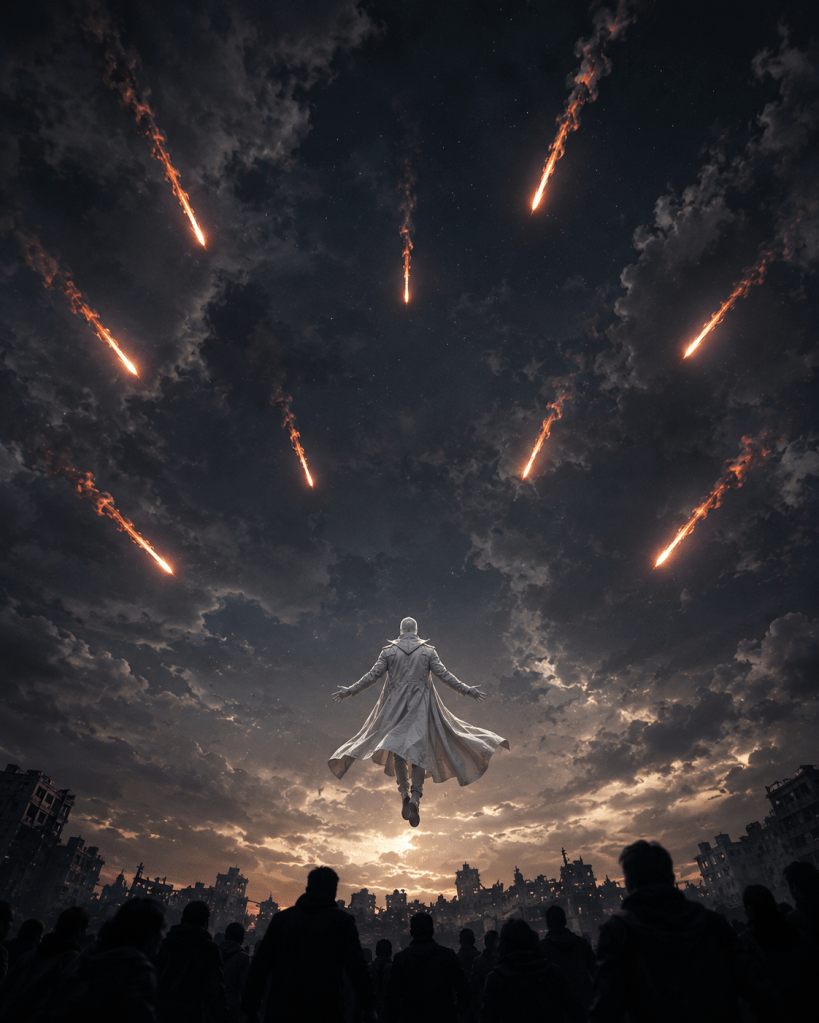
Rudhransh propelled upward at lightning speed. The white suit flashed under the sun as he streaked across the sky. In seconds, he reached one of the scattered drone units racing toward the city.
He thrust his chest forward. A sudden wave of blazing Urja burst outward from his core and struck the machine.
The unit exploded in mid-air with a deafening blast that shook the ground below. Windows rattled. People screamed and covered their ears.
Using the recoil of his own released force, Rudhransh shot sideways at even greater speed toward the next unit.
He reached it in a blink.
Another surge of Urja erupted from his core.
The second unit detonated in a ball of fire.
Gasps rose from every street, rooftop, and television screen across the nation.
Again he accelerated.
Again he struck.
Again the sky exploded.
The military men below forgot their orders. Policemen stood frozen. Reporters stopped speaking mid-sentence. Across homes, shops, offices, and tea stalls throughout India, millions watched their televisions and phones in stunned silence.
Rudhransh moved from one target to another like a streak of white lightning, each explosion propelling him faster than before.
Third.
Fourth.
Fifth.
Sixth.
Seventh.
Every airborne unit headed toward land was destroyed before it could descend beyond the skyline.
The final piece, the one that had flown seaward, dropped into the ocean before exploding with a thunderous bang. Water rose in a towering spray. Waves rushed outward and crashed against the Rainbow Bridge and the nearby jetty.
Lieutenant Chandra stood with his mouth hanging open.
“W… what was that?” he whispered.
People gathered near the perimeter slowly began stepping backward as Rudhransh descended from the sky toward them. Fear mixed with awe spread through the crowd.
He drove a powerful burst of Urja downward from his core. The force slowed his fall. Dust spiralled outward as he landed firmly on both feet.
For several seconds, nobody dared move.
Whispers rippled through the crowd.
“Isn’t he that masked man from the YouTube videos?”
“Yes… I think so. But he’s dressed differently.”
“Who is he?”
Rudhransh slowly raised his head. The metallic white mask hid his face. His voice emerged muffled and calm.
“I am Amanushak.”
He looked around at the terrified people.
“I will end this soon. Do not worry.”
A strange hush fell over the entire road.
“Ashwanth! Don’t let him leave!” Lieutenant Chandra shouted furiously from the approaching jeep with armed soldiers packed inside.
Ashwanth stood rooted beside Meena and the other officers, still staring at the figure in wonder.
He blinked, shook himself, and began moving forward.
Before anyone could reach him, Rudhransh thrust his chest downward and released a massive surge of Urja into the ground.
The street cracked beneath him. A shockwave blasted dust and loose debris in all directions.
Rudhransh launched upward like a missile and vanished into the sky.
Lieutenant Chandra leapt out of the jeep in fury.
“Why didn’t you move faster?” he roared.
Ashwanth, still looking upward at the empty sky, swallowed hard. “H-how, sir?” he asked.
(To be continued)
 Karun G Nath
Leave a Reply