
Sword and Dagger
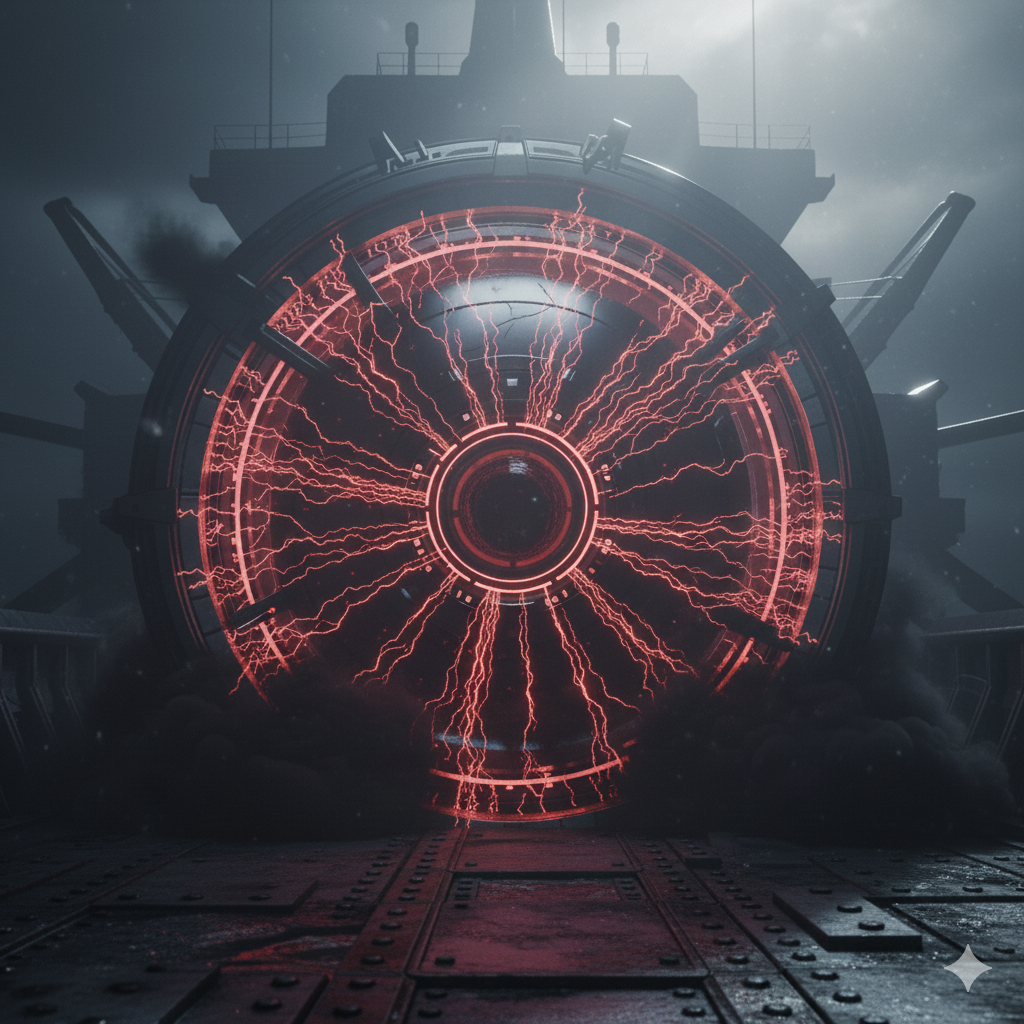
“Sir Ashura, Dr. Chaithra says it is time.” The soldier in a black combat uniform entered the captain’s cabin only after Ashura permitted him to do so.
“Okay. You may leave now,” Ashura said, rising slowly from his chair.
He lifted the knee-long overcoat draped over the backrest and slipped it on. One deep breath—measured, deliberate. Then he walked out of the office.
Ashura stepped onto the deck with a commanding presence, his hands clasped behind his back. Sixteen soldiers and ten researchers in lab coats bowed in unison.
He moved toward Dr. Chaithra, who stood beside a towering, womb-like core suspended within concentric stabilizer rings.
Its dark, spherical heart appeared inert, yet the air around it felt heavy—compressed, as though space itself were being restrained. Faint geometric veins pulsed across its surface, not with light, but with tension. It was not storing power, but the denial of release—a machine designed to hold reality at the edge of collapse.
“How long before we reach Shamba?” Ashura asked a soldier as he passed.
“ETA one hour, sir.”
“Good.”
He stopped beside Chaithra. “So, Doctor—tell me how this works again.”
Chaithra steadied herself. “Urja-Gharbha does not store energy in the conventional sense. There are no cells, no reactors, no containment chambers. What it stores is potential imbalance. When you release your Urja, the device does not absorb the wave. Instead, a lattice of quantum-elastic plates bends space at a microscopic level, forcing the energy into a paused state—neither released nor neutralized. This suspended instability is compressed through recursive resonance loops, multiplying the strain within the field itself. When released, the imbalance collapses violently, producing energy nearly a hundred times greater than the original output. The device does not amplify power—it amplifies the consequence of releasing it.”
Ashura studied the device for a moment longer than necessary. “Shall I give it my Urja?”
“Yes,” Chaithra said, then corrected herself. “Yes, sir.”
He walked toward the device.
Urja-Gharbha does not accept force.
It requires consent.
And alignment.
As Ashura stepped closer, the device detected the ordered emission from his core—not the power itself, but its rhythm. The stabilizer rings chimed softly and reoriented, tuning themselves to match his internal frequency.
The air tightened.
The surrounding deck fell unnaturally quiet.
A contact interface formed—not a socket, but a shallow circular plane of pressure at chest height.
He placed his palm against it.
Then he released a vast amount of energy from his core, channelling it through his hand and into the plane.
There was no surge.
Instead, Urja-Gharbha began to undo the order of his energy.
The Urja he released was drawn apart layer by layer, fractured into silent, opposing waveforms the instant it crossed the interface. His body did not feel drained—it felt misaligned, as though something fundamental within him was being gently, relentlessly turned against itself.
This was a completely different sensation from anything Ashura had ever felt while expending Urja.
Inside the device, the Quantum Compression Lattice trapped the distortion, not the flow. Each pulse he released became a held contradiction—frozen, multiplied, denied release.
He remained still.
Movement would disrupt alignment.
Resistance would cause backlash.
As the process continued, his breathing slowed without his control. The glow in his veins dimmed instead of intensifying. Time itself seemed fractionally delayed around him.
Urja-Gharbha grew heavier in presence, not brighter. The device did not respond with sound or light—only with increasing pressure.
When he finally withdrew his hand, nothing dramatic happened.
The device remained silent.
But something irreversible had been placed within it.
Chaithra hurried to his side and gripped his shoulder as he swayed.
“Drink this, sir. It will remove the aftereffects,” she said, handing him a small vial of colorless fluid.
Ashura drank it. Gradually, his internal rhythm stabilized.
“Thank you,” he said. “Is it done?”
“Yes, sir. As soon as we reach Shamba, we must transport Urja-Gharbha and attach it to Wamon. Once that is complete, I will activate it remotely from the ship after we gain sufficient distance.”
“Good.”
Ashura walked to the railing and looked toward the island now entering their vicinity. For the first time since stepping onto the deck, his reflection in the metal railing felt unfamiliar.
He generated a controlled pulling force from his core, anchoring it to the deck of a large vessel drifting near the ship. His body shot across the gap and landed firmly on its deck.
The Urja-Gharbha was then gently lowered onto the vessel by a crane extending from the ship, and more soldiers followed, boarding in quick succession.
Its engines roared to life.
The vessel moved toward the land several kilometers away.
A siren blared inside the ship.
Ashura turned sharply.
A soldier rushed onto the deck. “Sir, a surveillance ship has crossed into our zone. Four nautical miles out.”
Ashura’s expression hardened. He exhaled slowly, steadying himself.
“Call Sabo,” he ordered. “Tell her to clear it.”
“Roger, sir.”
The soldier ran.
Sabo emerged onto the deck from the bridge as the message reached her. An arming sword rested across her back, a talwar hung at her left hip, and a dagger sat at her right—all of them sheathed. The deck crew straightened instinctively, their eyes lowering.
“Ma’am, Sir Ashura said—” the soldier began, saluting.
“I know.”
She walked toward a compact escape craft suspended in the hangar, her face devoid of emotion. No one followed her with their gaze. They had learned better.
“Lower it,” she ordered.
Once the craft touched the sea, she leapt from the ship, landing cleanly on her feet. She pulled the ignition lever, and the craft surged forward, slicing across the water as it sped away from the ship.
The surveillance ship was smaller than a war vessel, its utilitarian deck stripped of ornamentation and crowded instead with tall sensor masts, dish antennas, and rotating optical arrays housed in weathered casings. It was a ship built to listen, not to fight. Uniformed personnel moved with restrained urgency—signal operators hunched over analog-digital consoles beneath open sky canopies, technicians adjusting calibration arms and antenna alignments, and armed deck guards stationed at measured intervals, their weapons held low but ready. No one spoke louder than necessary. Every eye was either on a flickering display or on the horizon, trained toward the distant silhouette of Ashura’s ship.
“New contact,” a sensor operator called out. “Small craft—detaching from the target vessel.”
The contact’s trajectory was clean and deliberate. It skimmed low over the water toward them, its signature sharp and unmistakable across radar and optical feeds alike. Guards raised their weapons as visual confirmation followed. Then, without visible deceleration drift or corrective thrust, the craft halted about half a nautical mile off the bow, engines idling in unnerving, mechanical stillness.
This was not a ship built for confrontation, but for observation—and the crew felt the sudden, unmistakable tension of people who realized they were no longer unseen.
Guards and operators alike remained fixed on the craft, tracking it through scopes, cameras, and rangefinders, waiting for an action that did not come.
“Has the craft moved?” The Lieutenant, who is leading the command and the communication centre, asked to the technician whose eyes were fixed on the radar. “No sir. It’s still halted.”
From beneath the dark water, Sabo approached the ship. The metal hull loomed above her like a silent shadow. She drew her talwar and traced a smooth line along the steel. The metal turned to dust and drifted away. She slipped inside and moved upward, cutting clean paths through decks and walls.
She entered the engine room while the machines were still running. One precise swing reduced the propeller shaft to ash. The ship slowed and died. Another cut severed the rudder’s control spine, leaving the vessel helpless.
A sudden thud echoed throughout the ship. Every crew member shook as the ship started behaving unnaturally. “What happened??” the Lieutenant shouted. “Sir! The bottom level of the ship is flooding. The rudder and the propulsion motor…” He stopped talking. “What happened to the rudder and the motor?” the Lieutenant asked. “It’s…It’s not there anymore sir.” The Lieutenant‘s face drained of colour. “Check the engine room and do the emergency patches to stop the flooding now. Now!” he shouted again.
A guard met Sabo near a corridor junction and raised his rifle. Sabo stepped inside his reach and cut once. He vanished. Two more rushed her—one fell as she rolled past his legs, the other a heartbeat later. Above them, four men fired blindly. Sabo used the walls, twisted through the narrow space, and ended them in seconds.
After that, it was brief and silent. Below decks, in offices and on the open deck, resistance ended almost as soon as it began. Dust settled where people had stood.
Only the communications office still had power.
Inside, operators shouted into headsets.
“Base, do you copy?”
“We’ve lost propulsion. Steering is unresponsive.”
From the other end, confusion answered.
“Repeat that.”
“Is this an attack?”
The door slid open. Sabo stepped inside.
“Are you the only ones handling communications on this ship?” she asked.
Lieutenant nodded stiffly. “Lieutenant Commander Rao. Communications lead. Yes. This room handles everything.”
Sabo drew the dagger.
The cuts were swift and exact. One man reached for her and ceased to exist. Another tried to flee and was erased mid-step. Rao never finished his breath.
The room was empty.
At the base, officers stared at their consoles.
“…Hello?”
“Why is this channel open?”
“Were we talking to someone just now?”
“No records,” another officer said quietly. “Nothing at all.”
The channel went silent. The ship drifted alone on the water, stripped of movement, voice, and memory.
(To be continued)
 Karun G Nath
Leave a comment